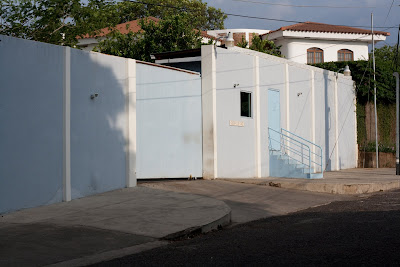
Peace Corps Office

>> Friday, June 12, 2009

The Peace Corps office in Managua has a lot of functions: it's (obviously) an office where people go to work, a meeting point for volunteers from all around the country, a doctor's office, a library, and an air-conditioned refuge for volunteers. It is especially easy for Holly and me to get to the office because it's right off of the highway that we have to take to get to Managua, so if we have a lot of work to do, it's worth the $1.50 roundtrip to go to the office and do the work in air conditioning and with free internet since there's basically no place in Masaya with air conditioning.

Here is the outside of the office. Up the stairs is the entrance into the security guards' office; they are always really friendly as we sign in, and always on guard for stray cars parked in front of the office or terrorists that may be passing through (the FBI's most wanted list and various terrorist pictures are prominently posted in their guard station, just in case) :
The fleet of Peace Corps Landcruisers that are ubiquitous in international development circles:
The front door:
Mimi really deserves her own entry; she is the receptionist at the office, but you can tell by the cards hanging around her office that she means way more than that to the volunteers. She has lots of responsibilities and is always busy, but she is on top of all of her duties and is never too busy to say hi when you walk in and to ask how everything is going. She also seems to recognize all volunteers' voices when she answers the phone, even if you're really sick and mumbling that you need to talk to a doctor. We really appreciate Mimi and will miss her very much when we leave. Gracias por todo, Mimi!
Karen started working as the project specialist for the TEFL sector just a couple of months before we arrived in 2007. Before that she was a Spanish teacher in the Peace Corps. During our two years, we have had three separate APCDs (the sector boss), but just one Karen. She has been wonderful and we can't thank her enough either--especially for those months when there wasn't an APCD to help shoulder the work load.

Here is Karen with her really adorable son, Ryan.
Here's the entrance to the Peace Corps medical office, a place we visited far too many times. Marva was responsible for making all our appointments, filling our prescriptions, and keeping everyone on schedule (a nearly impossible task), and Maria Elena, Mariano, Marta, and Ximena were the four doctors charged with keeping us healthy and sane.
The books in the PC library are all donated, and since no one is really responsible for upkeep, they usually look about like this. That said, there are always good books to read in there, and it's definitely part of the reason why we both read more than usual during our two years.
The bulletin board is also a little on the Laissez Faire side, but it lets volunteers find out about important new events, like who was elected president. There are also glimpses of the volunteer computers; there are supposed to be two in the lounge and two in another room, but at least one is almost always broken or missing.

Read more...

INJOCRUM

>> Thursday, June 11, 2009

Today is my last day of classes at my school, INJOCRUM (Instituto Nacional José de la Cruz Mena).  I’m actually pretty sad to be leaving the kids… though at the beginning of my service I sort of dreaded going to school, by the end I finally found my groove as a teacher and going to school became the only thing that I really enjoyed about being here.


Here’s where I walked daily to get from the market where I got off the bus to my school.  This is also where Marvin and company always harassed me:
This is the outside area of my school; this is before first hour when kids are just hanging out, playing soccer, and buying snacks:
Here’s the marching band at a competition my first year at INJOCRUM.  I never liked all the class we missed for the band to practice, but I did like their cheese grater instruments. 
I spent many, many hours in the teachers lounge since my teaching schedules always had a lot of free hours in them.  The barred doors in the first picture go to the principal’s office, the secretary’s office, and the vice principal’s office.  The painting in the second picture is of José de la Cruz Mena, the musician for whom the school is named.
These are some of the students I had my very first school year here, in first year (7th grade) in the morning with Francis.  The one in the middle is Eddyson, and he was one of my favorites:
This is my IV E (fourth year, section “E”) class from last year.  This class first made me enjoy coming to school, and I was legitimately sad when I no longer got to teach them.  They were all good kids that participated in class, did their homework, and laughed and my corny attempts to make jokes.
Here’s III G (third year, section “G”) from this year.  In the first picture they’re learning directions.  I had many of these same students last year in second year as well.


This is Rafael, one of my favorite kids that I had both last year and this year.  He loves to ask me how to say new phrases and then practices them on me later (like, “Teacher, welcome to our class!” “I am finished!” and “See you tomorrow, teacher!”).  Here he is showing off the chicken skeleton he made for science class.  They asphyxiated the chicken so as not to break any of its bones, and then he carefully disassembled it and glued it back together.  I think it’s really gross, but also pretty interesting.
Here’s Rafael’s class, III I, learning prepositions of place.
Finally, I’ll also miss the teachers.  This picture is from a staff meeting where we also had a dance competition to practice our solidarity.  This is Lila, who is an amazing seamstress and sews most of her own clothes (and also brings clothes and purses to school to sell to other teachers).  At the far left is Iris who took a long time to warm up to me, but eventually she learned my name (“Holly Regan, but not like Ronald Reagan, that’s it, right?”) and we became friends.
When the last bell rings at 5:45, the kids come pouring out of the gate to the school.  I rarely get out of school quickly enough to see the whole mess of students leaving to go home; these are a few stragglers that took more than 30 seconds to get out of school.
I never thought I’d say it, but I’ll actually miss being a teacher here.

Read more...
Botellón

>> Wednesday, June 10, 2009

One of the many chores that I get roped into just because I'm a man (see also taking the dogs out late at night, talking to strange people at the door, and cooking) is the weekly water bottle run. In our old house there was a pharmacy with water just down the street, but once we moved the closest place with water was the supermarket in the park, so I had to balance it on my bike. I'm pretty sure that by now with all of the frescos and helados we've had we are more or less immune to whatever is floating in the water, but it's nice knowing for sure that the water is clean.
Now we're living close again to Farmacia Carolina, but only for a short time to take advantage of the close access to clean water. I'm not sure we'll be able to find a place to live in the US that has 5-gallon jugs of water easily accessible by bike and/or foot. I guess that's just another sacrifice that I'm willing to make.

P.S. 1 week from today we'll be back in the States (and with any luck, we'll have Dorita in tow).

Read more...

Nicole

>> Tuesday, June 09, 2009

We’ve said before that you don’t really choose to become friends with other PCVs—it just happens. Nicole is one of the people in our group that we probably would have been friends with anyway. We’re usually the ones that stay at home rather than go out and party, and I mean this in the nicest way possible, but we’re all a little boring.

Nicole and I lived on the same block during training and since her Spanish was already pretty perfect when we got here, I would go to her for homework help, and during the week we would make frequent trips to Eskimo.
Even though now we live 5 hours apart, we still see her pretty often because she can stay here when she needs to pass through Managua or just needs a rest from San Dionisio. We went to visit her once, and that was enough for us. She and Dora are best buddies, too, and Dora treats her just like family by eating her underwear.

I think one time Nicole came to visit us and asked, "So... where are all of your friends?" I know she didn't mean anything by it, because that's just the way Nicole is. She makes friends with everyone everywhere she goes. We tried to explain that it's different being married in a big city, but ultimately she was a pretty good example of how to be a good volunteer. Everyone in San Dionisio will remember Neeecole for years and years, and if the goal is to give people in the host country a positive impression of Americans, the Peace Corps couldn't have chosen a better volunteer than Nicole.

Nicole is moving back home to Florida, and since everyone here assumes that everything not Nueva York or Virginia is just a part of Miami, we liked knowing someone that came pretty darn close to coming from the real thing. The whole family will miss her visits, and our tijera just won't know what to do without her. Even though Palo Alto and Lake Worth are pretty far apart, Palo Alto and Miami are just a short drive away (or so my neighbors just told me).

Read more...

9. Ten Things I Love about You (Nicaragua)

>> Monday, June 08, 2009

Though I listed yesterday the things I won't miss about Nicaragua, that doesn't mean it was all bad; there are plenty of things I already begin to feel nostalgic about, and we still have a few days left here!  In fact, the things that I disliked yesterday are exactly the same things I like and will miss about the place:


10.  Daily Life – For the last two years we haven’t had to worry about jobs, health care, or (until recently) housing. In the economic security sense, it will probably have been one of the least stressful periods of our adult lives. Our main teaching duties only require about 20 hours of actual work a week, and if we wanted to, we could just do that and spend the rest reading books or playing bocce ball.

9.  The Weather:  While six months of the year are a little too rainy or hot, the other six are pretty nice.  In December through February you can be guaranteed sunny, warm (but not too hot) days with a nice breeze.  It goes without saying that we never have to worry about snow or ice or being too cold, and it’s been nice not to have to worry about heat or air conditioning in our houses during this time.  We’ve become very finely tuned thermometers; I feel comfortable between about 82 and 88 degrees; any cooler and I feel cold, and any warmer and I feel hot. 

8. Food – We’ve eaten our share of gallo pinto, tejadas, and arroz de leche; we can’t honestly say we don’t enjoy the food here.  It’s also so much more convenient here—there are helados and ice cream and snacks for sale in nearly every house, and people go door to door selling other goods or come into buses to sell cheap, yummy food while we’re traveling.

7.  Inexpensive Wares – I think it goes without saying that on a Peace Corps volunteer’s budget, cheaper is better.  Beautiful hand-woven hammocks cost $10 and original paintings can be had for $5.  Additionally, people go door to door selling most things you could ever need, from food to universal remote controls to pillows.

6.  Transportation – Public transportation is inexpensive and prolific. We’ve been without a car for two years, but we only really regret it occasionally. Taking the bus is inexpensive and convenient to and from Masaya almost all waking hours (and several hours before waking).  Additionally, we can take a cab anywhere within our town for 50 cents or a ruta for 15 cents—I am quite sure we’ll never see such cheap transportation again, especially not in Palo Alto.

5. The Critters – Obviously Dora has earned a special place in our heart, along with other neighborhood dogs, little lizards, and Dora’s friends like Brown Dog, Luna, and Colacho.

4.  Culture – It is still kind of a shock to meet grown men living with their mothers without shame, but it is nice that strong family ties are important in Nicaraguan culture.  There’s also a distinct culture here in terms of holidays and celebrations, food, music, and beliefs—it’s very different from the States but sort of comforting at the same time.

3.  Being Different – It’s always easy for our friends to find out where we live once they get close enough because they can just ask the neighbors where the gringos live. Being different also gives us a chance to share our culture and ensures that no taxi ride passes in silence.

2.  Spanish – It’s great to know another language and we’ve learned a lot. Over the last week with the landlady drama our Spanish seems to have improved greatly. Also, English lacks some really useful phrase and words; some things like como no and fachento are just better in Spanish, and (with each other at least) I think we’ll continue to use them long after we leave here.

1.  People – We have made great friends in Nicaragua that we’ll be sad to leave, especially our counterparts, neighbors, volunteers, and Peace Corps staff.  We’ll be talking more about some of our closest friends and Nica family in our last few days here.

Read more...
THE CONTENTS OF THIS WEBSITE ARE OURS PERSONALLY AND DO NOT REFLECT THE POSITION OF THE U.S. GOVERNMENT OR THE PEACE CORPS.

  © Blogger template Palm by Ourblogtemplates.com 2008

Back to TOP